Failure pathways
Exploit paths, root causes, and blast-radius analysis across agent runtimes.
Published openly by BlockSiFr · Identity and Execution Governance
Identity and Execution Governance
for Autonomous Systems
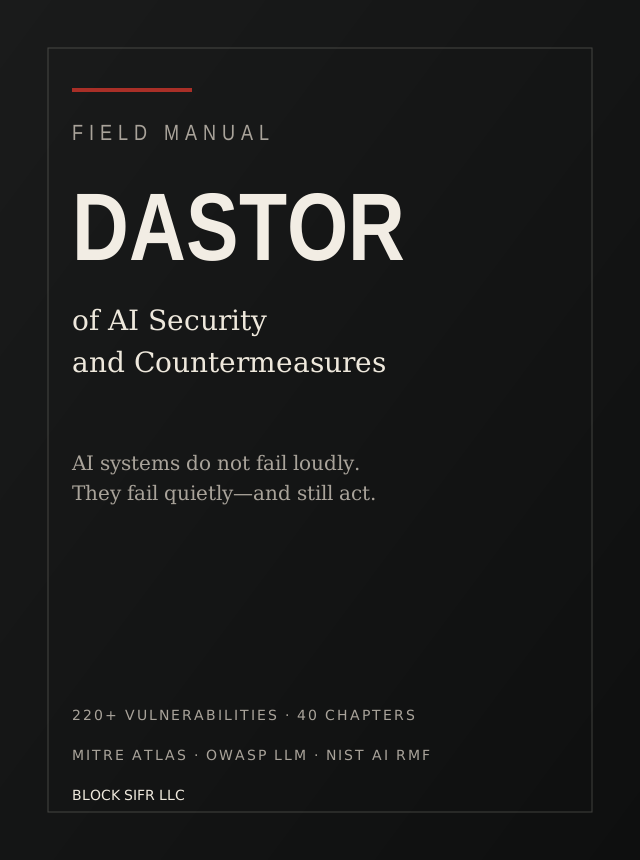
AI systems do not fail loudly. They fail quietly, and still act.
The public practitioner field manual for identifying, containing, governing, remediating, reversing, and proving failures across the AI execution stack.
Govern what systems may cause.
01 · Thesis
Classical software security assumes deterministic behavior: bounded inputs, explicit logic, and predictable execution paths. Those assumptions break when probabilistic inference systems can call tools, use identities, modify systems, move data, initiate transactions, and alter infrastructure.
If it can execute, it can be exploited.
If it cannot be proven, it cannot be governed.
Shift from Is the model safe? to Is this system authorized to cause this consequence under these exact conditions?
02 · Contents
Exploit paths, root causes, and blast-radius analysis across agent runtimes.
Numbered controls, detection guidance, and remediation playbooks for practitioners.
ExecutionReceipt patterns for proving what executed, under what authority, with what result.
Cross-walks to MITRE ATLAS, OWASP LLM Top 10, and NIST AI RMF.
03 · Execution stack
An apparently minor input or context failure can propagate into tool selection, execution, and persistent memory.
Open the interactive stack04 · Chapter explorer
05 · Audiences
Map failure pathways across the AI execution stack and prioritize controls that bind inference to authority.
Treat tool selection, memory, and orchestration as security surfaces, not product features alone.
Demand ExecutionReceipt-grade evidence for consequential AI actions under exact conditions.
Shift the question from “is the model safe?” to “is this system authorized to cause this consequence?”
06 · Frameworks
07 · Open chapter
Educational and practitioner content is public. Open Chapter 1 with no account, email gate, or unlock step.
Open Chapter10 · Doctrine and enforcement
The doctrine is public. Production assessment, integration, enforcement, evidence operations, and enterprise support are delivered by BlockSiFr.
Free doctrine. Open knowledge. Paid enforcement.